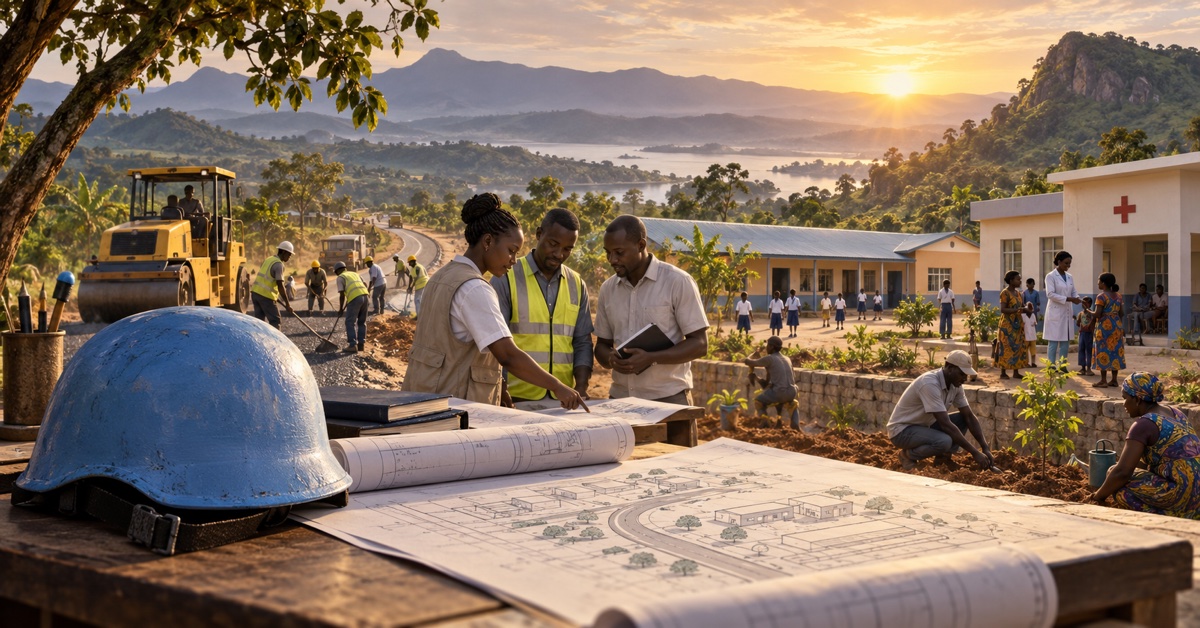
FROM ONUC TO MONUSCO (1960–2026): ANATOMY OF A SYSTEMIC FAILURE AND THE CASE FOR A CONGOLESE DOCTRINE OF SECURITY SOVEREIGNTY
An opinion manifesto for rebuilding the Congolese architecture of conflict prevention, civilian protection and strategic control of the national territory.
A forward-looking doctrinal opinion essay by Fernandez MURHOLA.
Advocate for international human rights law; practitioner of peace strategies, conflict prevention and resolution; expert in national resilience and territorial planning.
Graduate in Regional Planning, Institut Supérieur de Développement Rural (ISDR/Bukavu); graduate in Human Rights and International Humanitarian Law, Faculty of Law, University of Kinshasa (UNIKIN); graduate in Conflict Resolution, Department of Peace and Conflict Research, Uppsala University, Sweden; qualified in Defence and Resilience Strategies at the DRC’s senior military academy (2nd SS/CHESD).
Kinshasa, 5 October 2026
CONTENTS
I — From ONUC to MONUSCO: from emergency intervention to an institutionalised international presence
II — The security paradox: a massive presence without lasting territorial control
III — Keeping peace is not building peace
IV — The human cost: deaths, displacement, social destruction and sacrificed generations
V — The paradox of peace contributors and regional responsibilities
VI — The financial cost: assessing spending against the sovereign capacity it produces
VII — A temporary mission becoming a permanent structure
VIII — From permanent humanitarian emergency to sovereign reconstruction
IX — Stabilising instability: the operational paradigm problem
X — Accountability, abuses and the United Nations’ duty to lead by example
XI — International protection in the face of foreign aggression and occupation
XII — An orderly, conditional and irreversible MONUSCO exit
XIII — DRC Marshall Plan 2026–2040: USD 100 billion to turn fragility into sovereignty
XIV — Comparative lessons: the structural limits of contemporary peacekeeping
XV — The political economy of peacekeeping: interests, incentives, rents and dependencies
XVI — Comparative demonstration: why peacekeeping cannot substitute for state-building
General conclusion — Change the doctrine.
Annex — Proposed Security Council resolution.
Final word.
General introduction — Sixty-six years of international involvement: what strategic result?
On 14 July 1960, shortly after Congo’s independence, the United Nations Security Council adopted Resolution 143 and authorised the United Nations Operation in the Congo (ONUC). Its immediate aims included supporting the withdrawal of Belgian forces and helping the Congolese government respond to the crisis following independence.
ONUC left Congo in 1964. Thirty-five years later, in 1999, the United Nations returned with MONUC, which became MONUSCO in 2010.
In 2026, UN involvement in the DRC thus enters its sixty-sixth historical year, although it was plainly not continuous between 1964 and 1999. This chronological distinction is essential. The argument is not that the UN administered the DRC without interruption for sixty-six years. Rather, two major generations of UN operations have been deployed in the same political space without sustainably making an international security presence unnecessary.
That is the real doctrinal problem.
The question is not: “Have the United Nations sometimes saved lives?” The answer is unquestionably yes. The strategic question is: “Why, after decades of international engagement, does the DRC remain unable to guarantee, on its own and across its territory, the lasting security of its population and the effective integrity of its territory?”
This is a more demanding question, and a more analytical one. A public policy is measured not merely by its activity but by the lasting value it adds, its ability to produce autonomous institutions and its capacity to make its own apparatus progressively unnecessary.
Yet in 2026 the Security Council still maintains MONUSCO until 20 December 2026, with an authorised ceiling of 11,500 military personnel, 600 military observers and staff officers, 443 police officers and 1,270 members of formed police units.
The doctrinal question cannot be avoided: if a peace operation is meant to be temporary, why does its existence remain necessary after several decades?
The problem is not to deny MONUSCO’s achievements. It is that international assistance has not been sufficiently converted into national sovereignty. The DRC does not need another automatic extension of the status quo. It needs an organised transfer of capabilities. That is the core of this essay.
Chapter I — From ONUC to MONUSCO: from emergency intervention to an institutionalised international presence
1.1. ONUC: an operation born from a sovereignty crisis
ONUC was created in exceptional circumstances: recent independence, Belgian military intervention, Katangese secession, institutional weakness and the collapse of the security apparatus. Resolution 143 of 14 July 1960 called, in particular, for Belgium to withdraw its troops and provided for international assistance.
The Congolese experience immediately demonstrated a fundamental difficulty: an international operation can prevent some consequences of state collapse; it cannot, by itself, build the missing state. This is the first doctrinal lesson.
ONUC did not create the underlying causes of Congo’s crisis. It was deployed because those causes already existed. It would therefore be analytically excessive to attribute Patrice-Emery Lumumba’s assassination or every tragedy of the period directly to ONUC. But it would be equally excessive to treat the experience as a complete success. Congolese history already shows that an international presence does not, in itself, constitute an architecture of sovereignty.
1.2. From MONUC to MONUSCO
MONUC was established in 1999 during the Second Congo War. It became MONUSCO in 2010 with a broader stabilisation mandate. The change in terminology is revealing: peacekeeping → stabilisation.
But stabilisation of what? A sovereign state controlling its territory? Or a space in which several armed, political, economic and cross-border actors simultaneously exercise competing forms of power? That is the difficulty.
MONUSCO has carried out protection, escort and security operations, electoral support, documentation, disarmament and institutional assistance. But persistent violence shows that international action has not yet produced the complete transfer of capabilities that would enable the Congolese state to perform all its sovereign functions alone.
1.3. The Ugandan precedent
In 2005, the International Court of Justice ruled that Uganda had violated several international obligations through its activities in the DRC. In 2022, the Court set reparations owed by Uganda to the DRC at USD 325 million: USD 225 million for damage to persons, USD 40 million for damage to property and USD 60 million for damage related to natural resources.
This decision has major doctrinal significance. An international operation does not eliminate the possibility of foreign aggression or occupation. It therefore cannot replace the judicial and diplomatic mechanisms used to establish state responsibility.
The lesson is clear: peacekeeping must be connected with international justice, the prevention of aggression and state accountability.
Chapter II — The security paradox: a massive presence without lasting territorial control
The strongest criticism of MONUSCO is not that it has “done nothing”. It is more precise: the volume of international resources mobilised has not generated proportionate, lasting national security capabilities.
MONUSCO has sometimes protected communities, repelled offensives, secured routes, evacuated civilians and provided logistical capabilities that a fragile state lacked. But these tactical successes must not be confused with strategic victory.
2.1. Goma, 2012: a doctrinal shock
On 20 November 2012, M23 entered Goma while MONUSCO was present in the city. The United Nations acknowledged that M23 was in Goma and that the situation was critical.
This does not mean that peacekeepers were legally obliged to win a war for the DRC. It reveals something more important: international protection is limited when it is not supported by national state capabilities able to retake, administer and retain territory sustainably.
2.2. The Intervention Brigade: the exception that proves the rule
Resolution 2098 of 2013 established MONUSCO’s Intervention Brigade, with a particularly robust mandate against armed groups. This was a historic departure. But it also exposed a contradiction: the more militarised a peace mission becomes, the closer it may move towards a function the state should normally perform itself.
How long can an international operation exercise security functions without unintentionally delaying the development of the corresponding national capabilities?
2.3. The problem is not “more peacekeepers equals more armed groups”
A rigorous argument must not claim that the UN presence caused the proliferation of armed groups. Direct causation has not been established. But one observation is undeniable: international presence and the persistent proliferation of armed groups have coexisted for decades. That is already a major evaluation problem.
An operation can reduce violence locally without sufficiently reducing the structural capacities that reproduce it. The real paradox is therefore: temporary reduction of violence ≠ lasting disappearance of conflict.
Chapter III — Keeping peace is not building peace
Confusion between peacekeeping, peacemaking, peacebuilding and state-building is a fundamental weakness of international stabilisation policies.
3.1. Peacekeeping
Peacekeeping primarily seeks to prevent renewed or escalating violence in a specific context. But a peacekeeping mission cannot, on its own, create:
- a professional national army;
- an independent judiciary;
- an effective territorial administration;
- a productive economy;
- secure borders;
- an effective national taxation system;
- a stable land policy;
- a defence industry;
- a democratic political culture.
3.2. Mediation is not enough
The DRC has experienced many peace processes: Lusaka, Sun City, Goma, Addis Ababa, Nairobi, Luanda and other initiatives. They have produced agreements, ceasefires, monitoring mechanisms and sometimes considerable progress.
But an agreement is not yet peace. A political agreement becomes lasting peace only when it is transformed into institutions capable of resisting the interests that produced the war.
3.3. Lasting peace requires five forms of sovereignty
The new Congolese doctrine must rest on five capabilities:
- Territorial sovereignty: the state effectively controls its territory.
- Security sovereignty: the state has a professional, republican and accountable public force.
- Judicial sovereignty: serious crimes are prosecuted without discrimination.
- Economic sovereignty: natural resources finance national development rather than war economies.
- Institutional sovereignty: the state has a territorial administration able to operate without permanent international assistance.
Chapter IV — The human cost: deaths, displacement, social destruction and sacrificed generations
Debate about MONUSCO cannot be reduced to budget tables. The real unit of measurement must be the human being.
An International Rescue Committee study estimated 5.4 million excess deaths between August 1998 and April 2007. This estimate mainly concerned indirect deaths associated with disease, malnutrition and the collapse of living conditions; it was not a count of people directly killed in combat.
This distinction is essential. But it makes the situation even more serious: prolonged war destroys a society even when weapons do not kill directly.
Preventable mortality, malnutrition, collapsing health services, exclusion from schooling, sexual violence, destroyed livelihoods and forced displacement are forms of social destruction.
In 2024, the United Nations reported approximately 7.3 million displaced people in the DRC, including 6.9 million in the eastern provinces.
Humanitarian doctrine must therefore evolve. Temporary protection is no longer sufficient; the structural conditions for return must be created.
The real indicator must be not only “How many people have we assisted?” but “How many people no longer need assistance because they have regained security, land, housing, school, healthcare and economic activity?”
Chapter V — The paradox of peace contributors and regional responsibilities
The international system must resolve a major contradiction: a state may contribute to UN peace operations while simultaneously facing serious international allegations or decisions about its role in a regional conflict.
Participation in a peace operation must nevertheless be treated neither as proof of innocence nor as a presumption of guilt. Rwanda’s case illustrates the need for rigorous institutional scrutiny.
In February 2025, the Security Council, acting under Chapter VII, condemned M23 offensives and called on Rwanda to cease supporting M23 and withdraw the RDF from DRC territory. In 2025, the Group of Experts on the DRC subsequently described an intensification of the conflict and major territorial gains achieved jointly by AFC/M23 and the RDF, notably around Goma and Bukavu.
The doctrinal conclusion is not that troop contributors should be excluded from peace operations. It is more demanding: participation in an international peace operation must be subject to stronger mechanisms of compliance, traceability and international accountability.
No state should enjoy both the political prestige of peacekeeping and the absence of credible scrutiny when its involvement in a regional crisis is called into question.
Chapter VI — The financial cost: assessing spending against the sovereign capacity it produces
Financial criticism must also be rigorous. It would be intellectually weak to claim that every dollar spent on MONUSCO could have been transferred directly to the FARDC or to infrastructure.
A mission’s budget finances many functions: personnel, transport, aviation, security, logistics, administration, protection, information, infrastructure and operations.
But another question remains entirely legitimate: what proportion of the resources mobilised has produced lasting, transferable Congolese capabilities? This question must now become compulsory.
UN budget documents continue to allocate substantial resources to MONUSCO and its transition process. In 2026, the ACABQ is still publishing documents concerning its financing for 2026–2027.
A meaningful audit must measure:
- infrastructure transferred;
- equipment transferred;
- communication systems transferred;
- data and early-warning capabilities transferred;
- skills developed through training;
- national institutions strengthened;
- territories becoming autonomous;
- judicial mechanisms becoming operational.
The principle must be simple: every international dollar invested in the DRC must produce either immediate protection or lasting Congolese capacity.
Chapter VII — A temporary mission becoming a permanent structure
MONUC was created in 1999. It became MONUSCO in 2010. It remains in the DRC in 2026. Duration is not, in itself, proof of failure: some international crises are exceptionally long. But a temporary mission must be assessed by its ability to make its presence progressively less necessary.
The Security Council has already begun a gradual withdrawal process. MONUSCO completed its withdrawal from South Kivu in June 2024, after more than twenty years in the province. Resolution 2808 nevertheless extends its mandate until 20 December 2026.
The doctrinal question is no longer “Should MONUSCO be maintained indefinitely?” It is “How can withdrawal become a mechanism for transferring sovereignty?”
Withdrawal must therefore be conditional on a specific transfer plan covering:
- infrastructure;
- logistical resources;
- medical capabilities;
- early-warning systems;
- geographical data;
- communication resources;
- training;
- civilian protection mechanisms;
- judicial documentation;
- coordination chains with national authorities.
Chapter VIII — From permanent humanitarian emergency to sovereign reconstruction
Humanitarian emergency action is indispensable when a population is threatened. But emergency response cannot become a permanent development model.
A society cannot be rebuilt solely through:
- food distributions;
- emergency kits;
- camps;
- temporary shelters;
- short-term projects;
- consultancy missions;
- successive humanitarian funding cycles.
The new doctrine must reverse the logic:
- From assistance to production.
- From camps to housing.
- From displacement to secure return.
- From kits to lasting assets.
- From food aid to productive agriculture.
- From temporary projects to permanent infrastructure.
- From service-providing NGOs to strengthened public institutions.
Reconstruction must be conceived as a security policy. A village with electricity, connections, administration, schools and a viable economy is less vulnerable to armed-group control than an abandoned village. Development thus becomes an infrastructure of peace.
Chapter IX — Stabilising instability: the operational paradigm problem
An international mission can protect a base without sustainably controlling its surroundings. It can temporarily secure a road without rebuilding the national road network. It can escort displaced people without removing the cause of their displacement. It can finance a disarmament, demobilisation and reintegration programme without eliminating the economic incentives to rearm. It can produce thousands of reports without creating a national judiciary able to turn them into prosecutions.
This is what I call stabilising instability. It is not an allegation of bad faith against international personnel. It is a criticism of the system.
A public policy becomes paradoxical when it reduces symptoms without sufficiently reducing the mechanisms that reproduce the problem.
The new strategic indicator must therefore be: how many Congolese territories can operate sustainably without international security assistance? This indicator must guide MONUSCO’s transition.
Chapter X — Accountability, abuses and the United Nations’ duty to lead by example
An institution that claims to protect human rights must apply to its own personnel the standards it demands of states.
Sexual exploitation and abuse scandals involving some UN personnel in the DRC have profoundly damaged the Organisation’s credibility. Investigations following events in Bunia revealed the seriousness of certain allegations, including allegations involving minors. The issue was not the conduct of all peacekeepers, but the system’s ability to guarantee a credible, rapid judicial response.
The doctrine must be unambiguous: even one victim of sexual exploitation is one victim too many.
What is needed is:
- an independent complaints mechanism;
- protection for victims and witnesses;
- prompt investigation;
- mandatory referral to the competent authorities;
- publication of prosecution statistics;
- exclusion of personnel found guilty;
- effective reparation for victims.
Zero tolerance must work both ways: zero tolerance for abuse by international personnel, and zero tolerance for attacks against UN personnel. International legitimacy rests on that symmetry.
Chapter XI — International protection in the face of foreign aggression and occupation
The Congolese case raises a fundamental question for collective security: what is an international presence worth when a serious violation of territorial sovereignty persists within its operational theatre?
The International Court of Justice established Uganda’s responsibility for its military activities in the DRC and subsequently determined the reparations owed. In 2025, the Security Council unanimously adopted Resolution 2773, condemning M23 offensives and calling, in particular, on the RDF to cease supporting M23 and withdraw from Congolese territory.
These facts demonstrate a fundamental truth: civilian protection and the defence of territorial sovereignty cannot be separated from coercive diplomacy and international accountability.
A new architecture must therefore combine temporary international protection + permanent national defence + regional diplomacy + international justice + targeted sanctions + control of natural resources.
We must move from merely managing consequences to deterring causes.
Chapter XII — An orderly, conditional and irreversible MONUSCO exit
The DRC must neither demand an irresponsible departure nor accept an indefinite presence. It must require a strategic transition. MONUSCO’s current mandate expires on 20 December 2026.
The proposed doctrine rests on six principles:
Principle 1 — No security vacuum: no withdrawal must create an abandoned zone.
Principle 2 — No automatic renewal: any possible renewal must be subject to measurable objectives.
Principle 3 — Capability transfer: relevant infrastructure and equipment must be transferred or repurposed according to a transparent inventory.
Principle 4 — Knowledge transfer: useful data, early-warning systems, maps, procedures and skills must be transferred to Congolese institutions.
Principle 5 — National responsibility: the Congolese government must present a public plan to build up its security institutions.
Principle 6 — Transitional international guarantee: the international community must continue to support the DRC financially, technically and diplomatically during the transition.
MONUSCO’s withdrawal must not mean the world withdrawing from the DRC. It must mean the end of a substitutive presence and the beginning of a sovereignty partnership.
Chapter XIII — DRC Marshall Plan 2026–2040: USD 100 billion to turn fragility into sovereignty
MONUSCO’s exit cannot be credible without massive investment in national capabilities. I therefore propose a USD 100 billion DRC Marshall Plan for 2026–2040, conceived not as additional humanitarian assistance but as an international programme for sovereign reconstruction.
The main pillars of this post-conflict reconstruction plan follow.
PILLAR I — SECURITY AND DEFENCE: USD 40 BILLION
Objectives and indicators:
- professionalising the FARDC;
- military training;
- war colleges;
- specialised academies;
- territorial intelligence;
- border surveillance;
- secure communication systems;
- air and logistical capabilities;
- drones and surveillance resources;
- radar;
- national maintenance capabilities;
- military infrastructure;
- reform of the chain of command;
- improved living conditions for military personnel.
Priority must go to national defence capability, not simply to increasing troop numbers.
PILLAR II — JUSTICE, TRUTH AND REPARATION: USD 15 BILLION
Create:
- specialised courts;
- a hybrid judicial mechanism;
- witness protection;
- investigation units for international crimes;
- forensic laboratories;
- judicial archives;
- a national reparation system;
- programmes for survivors of sexual violence;
- prisons meeting international standards.
The Mapping Report must be used as a historical and documentary foundation for judicial work, with due respect for applicable evidentiary standards.
PILLAR III — RETURN, RESETTLEMENT AND RECONSTRUCTION: USD 20 BILLION
Priorities:
- voluntary, safe and dignified return;
- a land registry;
- secure land tenure;
- housing;
- schools;
- health centres;
- drinking water;
- energy;
- rural access roads;
- local markets;
- rehabilitation of destroyed rural areas.
Reconstruction must aim not only at physical return but also at economic and social reintegration.
PILLAR IV — INFRASTRUCTURE FOR SOVEREIGNTY: USD 20 BILLION
Invest in:
- national roads;
- provincial roads;
- east–west corridors;
- north–south corridors;
- bridges;
- waterways;
- energy;
- fibre optics;
- border infrastructure;
- ports and logistics platforms;
- a national land registry;
- public digital networks.
A disconnected border is a vulnerable border. An isolated territory is difficult to administer.
PILLAR V — GOVERNANCE AND THE RULE OF LAW: USD 5 BILLION
Priorities:
- territorial administration;
- digital civil registration;
- accessible local justice;
- customs control;
- the Court of Auditors;
- parliamentary oversight;
- citizen auditing;
- budget transparency;
- anti-corruption measures;
- digitisation of public services.
Governance of the Marshall Plan
The Marshall Plan must be:
- Congolese in its leadership;
- international in its financing;
- parliamentary in its oversight;
- judicial in its accountability;
- audited in its spending;
- public in its results.
This calls for a National Reconstruction and Sovereignty Authority, subject to constitutional, parliamentary and judicial oversight.
An international support council could include the African Union, the United Nations, international financial institutions and bilateral partners, with these requirements:
- Every dollar must be traceable.
- Every project must have an indicator.
- Every indicator must have a responsible person.
- Every responsible person must be auditable.
Chapter XIV — Comparative lessons: the structural limits of contemporary peacekeeping
The Congolese experience must be placed within the global history of peacekeeping. The United Nations reports having deployed 71 peacekeeping operations since 1948, with more than two million people serving under its flag over the decades.
This global experience does not justify the conclusion that “the UN fails everywhere”. That would be false. Missions have helped reduce violence, supervise ceasefires, support political transitions and protect populations.
However, several crises reveal the model’s limits when the political conditions for lasting peace are absent.
14.1. Palestine — UNTSO
The mission established in 1948 remains active in 2026. Its longevity demonstrates that a mission can help manage a conflict without being able to resolve its fundamental political causes.
14.2. Bosnia — Srebrenica
Srebrenica had been designated a “safe area” by the Security Council. Protection proved insufficient, and the massacre of July 1995 remains one of international protection’s most tragic failures.
14.3. Rwanda — UNAMIR
UNAMIR illustrates the danger of an inadequate mandate in the face of a genocidal process. The Security Council reduced the force from 2,548 to approximately 270 troops on 21 April 1994, while the genocide was under way. The lesson is fundamental: a mission lacking resources commensurate with its responsibilities cannot be assessed solely by its operational activity.
14.4. Haiti
MINUSTAH also demonstrates that international operations can produce unforeseen and gravely harmful effects. The cholera epidemic associated with the presence of Nepalese peacekeepers caused lasting damage to trust in the Organisation.
14.5. Mali
MINUSMA ultimately left Mali following a request from the Malian authorities and a Security Council decision. The lesson is not that every peacekeeping mission is useless. It is that without sustained political consent, national ownership and a credible exit strategy, even a heavily financed operation can become politically unsustainable.
Chapter XV — The political economy of peacekeeping: interests, incentives, rents and dependencies
Peacekeeping is generally presented as an exclusively humanitarian, security and diplomatic activity. That description is incomplete, because peacekeeping is also a financially lucrative activity.
Any long-term international operation also constitutes an economic, institutional, administrative and geopolitical ecosystem, in which billions of dollars, jobs, contracts, equipment, services, data, skills and influence circulate.
The question is not to argue that “international actors want war”. That would be simplistic and analytically unprovable. The real question is more serious: what economic, institutional and geopolitical incentives are created by the indefinite extension of a peacekeeping operation, and are those incentives compatible with the ultimate objective of making the operation unnecessary?
This is the question that must be asked in the DRC.
15.1. Moving from a crisis economy to an economy of crisis resolution
A prolonged crisis necessarily creates an economy around it. When a crisis lasts a few months, actors mobilise to resolve it. When it lasts several years, specialised institutions emerge. When it lasts several decades, a permanent ecosystem of crisis management may take shape.
This ecosystem includes international personnel; UN agencies; international NGOs; national NGOs; consultants; transport companies; airlines; fuel suppliers; security companies; construction firms; telecommunications; hotels; housing; catering; medical services; audit firms; consultancies; international experts; training organisations; and financial partners.
None of these actors is inherently illegitimate. The problem arises when the economy of managing the crisis becomes more structured than the economy of resolving it.
The strategic question becomes: how many international resources are devoted to maintaining the ability to manage the crisis, and how many are devoted to eliminating the conditions that allow it to recur? This is a fundamental distinction.
15.2. “Crisis rent”: a concept to examine without conspiracy theories
An essential concept must be introduced here: crisis rent. A crisis rent arises when a lasting emergency generates financial, professional or institutional flows that objectively depend on that emergency’s persistence.
This concept must not be understood as an allegation of complicity in war. A humanitarian doctor does not necessarily wish for an epidemic. A peacekeeper does not necessarily wish for war. A consultant does not necessarily wish for state fragility. An NGO does not necessarily wish for displacement to persist.
But the system may nevertheless produce a situation in which the persistence of the problem guarantees continuing demand for services intended to manage it. This is a classic political-economy problem.
We must therefore analyse not only individual intentions but also institutional incentives.
15.3. MONUSCO as an economic ecosystem
An international mission on MONUSCO’s scale is not only a military force. It mobilises considerable infrastructure: bases; aviation; land transport; fuel; food; maintenance; communications; equipment; security; medical services; accommodation; information technology; engineering; administration; recruitment; and training.
Every function entails an expenditure. Every expenditure corresponds to a market. Every market creates economic beneficiaries.
The doctrinal question is therefore not “Why does the UN spend money?” It is “What share of that spending becomes a permanent asset for the Democratic Republic of the Congo after the mission leaves?” That is the real indicator.
15.4. The peace-budget paradox
A budget worth several billion can produce a considerable volume of activity without necessarily producing an equivalent amount of sovereignty.
Two types of expenditure must be distinguished.
A. Operating expenditure: this enables the mission to function—salaries, vehicles, fuel, food, travel, security, aviation and administration. It is necessary, but largely consumed.
B. Capability expenditure: this creates something that remains—a school, hospital, communication network, laboratory, judicial system, infrastructure, training centre, early-warning system, transferred equipment or technological capability.
The first enables the mission to function. The second enables the country to function after the mission. A transition doctrine must progressively shift the centre of gravity from the first to the second.
15.5. International professional rent
Peace operations also constitute a global market for highly skilled labour. Thousands of people may be mobilised around security, law, logistics, medicine, engineering, administration, political analysis, human rights, mediation, communication and project management.
Again, this is not illegitimate. But a problem arises when international skills remain external rather than being transferred.
A mission may employ foreign specialists for twenty years without the country possessing, when they leave, an equivalent number of national specialists able to perform the same functions.
The question therefore becomes: how many Congolese capabilities have been developed for every international capability mobilised? This question should appear in every mission evaluation report.
15.6. The technology-transfer deficit
The same problem exists in technology. A modern operation uses communication systems, digital mapping, imagery, geolocation systems, drones, aerial surveillance, information systems, databases, analytical tools and early-warning systems.
But a technology temporarily used by a mission is not necessarily a technology mastered by the host state. There is a difference between using technology and possessing technological capability.
The new doctrine must require: international use → technology transfer → Congolese ownership and mastery → national production.
The real objective must not merely be for the DRC to keep using foreign systems after MONUSCO leaves. It must be for the DRC gradually to maintain, adapt and integrate them and, wherever possible, produce them itself.
15.7. Troop-contributing countries: an international economy of force
Peace operations rely heavily on states contributing troops and police personnel. The United Nations reimburses contributing countries through standardised mechanisms.
This system has an economic rationale: wealthy countries finance it; contributing countries provide soldiers; the UN coordinates; the mission uses those forces on the ground.
But it also produces an asymmetry. Some states may turn their participation in peace operations into a source of military revenue, operational experience, access to equipment, professionalisation, diplomatic visibility and international influence.
Two things must therefore be distinguished: contributing to peace, which is legitimate; and strategically using that contribution as an instrument of power, which must be subject to stronger scrutiny.
15.8. Rwanda’s case: the problem of systemic coherence
Rwanda deserves particular attention not because the principle of peace operations should be challenged, but because its case reveals an institutional contradiction.
Rwanda is a significant contributor to peace operations. At the same time, in 2025 the Security Council condemned support for M23 and called on the RDF to cease supporting the movement and withdraw from Congolese territory.
The doctrinal problem is this: how can the international system simultaneously value a state’s military contribution to peace operations and address the responsibilities attributed to it in a regional conflict?
The answer must not be automatic exclusion. It must be independent verification, traceability, accountability, targeted sanctions, scrutiny of chains of command and transparency about external operations.
The status of peace contributor must never become a certificate of diplomatic immunity.
15.9. The logistics industry of peace
Peace operations require enormous logistics: moving personnel, supplying bases, maintaining vehicles, transporting equipment, ensuring communications, building and maintaining infrastructure, providing aviation and healthcare, and securing facilities. This necessarily generates an economic sector.
But Congolese doctrine must impose a new requirement: an increasing share of logistical expenditure must produce Congolese assets and skills.
For example, rather than systematically importing services, train Congolese mechanics; develop maintenance workshops; train logisticians; develop competitive Congolese businesses; build national logistics platforms; and develop a national aeronautical capability.
Temporary expenditure then becomes permanent investment.
15.10. The economy of NGOs and consultants
International humanitarian action also represents a substantial professional sector, with agencies, programmes, projects, consultants, evaluators, coordinators, consultancies, training and audit missions.
This system produces valuable skills. But there is a risk of turning Congolese people into permanent beneficiaries rather than producers of solutions.
A sovereignty policy must therefore invert the pyramid. International expertise must progressively become supporting expertise → skill transfer → joint leadership → national leadership.
The ultimate objective is for Congolese institutions to design, finance, implement and evaluate their own policies.
15.11. The problem of projects without lasting national assets
Another phenomenon must be challenged. An international project may last three years, with a budget of several million, a large team, numerous reports, workshops and evaluation missions.
Then funding ends. The project disappears. Staff leave. Vehicles are sold or reassigned. Bases close. The population returns to the same fragility. This is the syndrome of projects without lasting consolidation.
The new doctrine must impose a rule: no major international project should be considered successful unless it leaves behind lasting institutional, human, technological or infrastructural capacity.
15.12. National elites: avoiding a one-sided interpretation
Criticism must not target international actors alone. Domestic actors may also sustain external dependency.
Why? An international presence may temporarily compensate for institutional weakness, provide capabilities the state lacks, reduce immediate pressure on the government, allow difficult reforms to be postponed and offer external security capacity where national institutions are inadequate.
There is therefore a risk of weakening national responsibility.
A sovereignty doctrine must be clear-eyed: external dependency cannot be eliminated unless internal responsibility is strengthened at the same time. The DRC must therefore accept its own share of responsibility for building its institutions.
15.13. Armed groups and the war economy
Conflict also creates parallel economies involving illegal taxation, territorial control, mining, cross-border trade, trafficking, extortion, recruitment, road control, land-based economic activity and smuggling.
For some actors, as long as these revenues exceed the cost of disarmament, war has an economic rationale.
That is why disarmament, demobilisation and reintegration cannot be exclusively military. It must be accompanied by control of financial flows, mineral traceability, border security, economic alternatives, justice, dismantling of financing networks and local development.
A war economy can only be disarmed sustainably by building a peace economy that is more profitable, lawful and inclusive.
15.14. Natural resources: war as an economic problem
Congolese conflict cannot be separated from natural resources. When an armed group controls a resource-rich territory, it potentially possesses a financing source, a taxation mechanism, a bargaining tool, a recruitment instrument and regional leverage.
Peace must therefore change the economic equation. We must move from:
Resource → armed control → taxation → war financing
To:
Resource → traceability → public taxation → local processing → infrastructure → employment → development → stability.
That is why mining policy is also national security policy.
15.15. The P5 and geopolitical governance
The Security Council is not economically neutral. Its five permanent members hold particular power through their right of veto. Peace operations are therefore embedded in an architecture of power.
It would nevertheless be simplistic to claim that the five powers act as a homogeneous bloc. They have different interests, strategies, alliances, economic interests and interpretations of conflicts.
But one reality remains: the international security system is governed by sovereign states whose strategic interests do not always coincide with those of the state in which a mission is deployed.
The DRC must therefore move from being a passive beneficiary to being a diplomatic actor able to defend its interests within the multilateral system.
15.16. The real problem: the asymmetry between what is spent and what remains
This is the heart of the chapter. The question is not “How much does the UN spend?” It is “What proportion of this spending becomes a sovereign Congolese asset?”
Imagine two scenarios.
Scenario A — Crisis management: USD 100 goes to transport, salaries, fuel, security, accommodation and administration. The crisis continues. When the mission leaves, USD 100 has been consumed.
Scenario B — Building sovereignty: USD 100 goes to training, infrastructure, justice, intelligence, roads, energy, technology and administration. When the mission leaves, Congolese capability remains.
The difference is doctrinal. The first model finances the presence. The second finances the end of that presence.
15.17. A new indicator: the “sovereignty coefficient”
I therefore propose a new indicator for evaluating international operations: the Transferred Sovereignty Coefficient — CST, retaining the French acronym.
It would measure the relationship between international resources mobilised and sovereign capabilities effectively transferred or created.
The CST could incorporate infrastructure transferred; national personnel trained; equipment transferred; technology mastered; information systems transferred; judicial capabilities created; territories becoming autonomous; administrations strengthened; new tax resources; and populations moving permanently beyond emergency conditions.
A mission could thus be assessed not only by how much it spent, but by how much sovereignty it produced. This is a conceptual revolution.
15.18. A new rule: every dollar must leave a capability
Future international cooperation in the DRC should be organised around a simple principle: “NO CAPACITY, NO EXIT.”
In other words, no exit without capability transfer—but also no extension without a demonstrated added value.
Each year, the Security Council should ask: how many infrastructure assets have been transferred? How many Congolese people have been trained? How many territories now function without international support? How many technological systems have been brought under national control? How many judicial procedures are now autonomous? How many displaced people have regained a sustainable life? How many military capabilities have actually been consolidated? What share of the budget has produced a lasting asset?
If the answers are insufficient, the model must be reformed.
15.19. From an economy of presence to an economy of exit
The real reform is therefore not less money for the DRC. It is a different use of money intended for the DRC.
We must move from spending on presence to investing in sovereignty; from international personnel to skill transfer; from temporary projects to permanent infrastructure; from assistance to production; from maintenance to construction; from crisis management to crisis prevention; from dependency to resilience.
15.20. The doctrinal conclusion of Chapter XV
It would be intellectually irresponsible to claim that MONUSCO exists because certain actors want war to continue. Reality is more complex. But it would be equally irresponsible not to examine the economic and institutional incentives generated by a prolonged international presence.
After decades of operations, the fundamental question is: is the international system organised to make its own presence progressively unnecessary?
If the answer is no, the problem is not individuals’ goodwill. It is architectural.
A peace mission should never have becoming indispensable as an implicit objective. Its ultimate success should be paradoxical: its own disappearance because national institutions have become strong enough to perform the functions it temporarily exercised.
That is why the DRC must now defend a new international doctrine: “INTERNATIONAL ASSISTANCE MUST BE MEASURED BY THE SOVEREIGNTY IT PRODUCES.”
Not only by the number of troops deployed, projects financed, reports produced, meetings organised or dollars spent.
The real success indicator must be: HOW MUCH CONGOLESE CAPACITY REMAINS AFTER INTERNATIONAL PERSONNEL LEAVE?
Only then can international assistance cease to be an economy of crisis management and become an economy of crisis resolution. This transformation must be at the heart of the Congolese Doctrine of Security Sovereignty.
Peace must no longer be a market for managing fragility. It must become a collective investment in eliminating the causes of fragility.
In other words: FROM AN ECONOMY OF PRESENCE TO AN ECONOMY OF SOVEREIGNTY. FROM CRISIS RENT TO PEACE INVESTMENT. FROM INTERNATIONAL MANAGEMENT OF FRAGILITY TO CONGOLESE PRODUCTION OF RESILIENCE. AND FROM DEPENDENCY TO SOVEREIGNTY.
Chapter XVI — Comparative demonstration: why peacekeeping cannot substitute for state-building
The argument is not that the United Nations is useless. It is far more precise: no peacekeeping operation can sustainably replace a state capable of exercising its sovereign functions.
Global experience offers several configurations.
First configuration — Freezing the conflict: a mission temporarily prevents war from resuming. This is a positive result. But without a political solution, the conflict remains frozen.
Second configuration — Humanitarian protection: the mission saves lives and temporarily protects populations. This is a positive result. But if the state remains absent, the need for protection returns.
Third configuration — Political transition: the mission supports an electoral or institutional process. This is a positive result. But if institutions remain fragile, the crisis may reappear.
Fourth configuration — Insufficient coercive capability: the mission has a legally significant mandate but inadequate political or military resources. The result is a gap between mandate and reality.
Fifth configuration — No transfer of sovereignty: the mission progressively performs functions that the state should exercise. The paradoxical result is that the more indispensable the mission becomes, the less it achieves its ultimate objective of making its presence unnecessary.
This is where the Congolese question lies.
General conclusion — Change the doctrine
The DRC must not choose between two extremes: permanent international dependency or a sudden, irresponsible withdrawal. It must choose a third path: TRANSITION TOWARDS SOVEREIGNTY.
This transition rests on a simple equation: temporary international protection + capability transfer + national reconstruction + justice + regional diplomacy + security sovereignty.
The world must not abandon the DRC. But it must stop treating international presence as a permanent substitute for state-building.
MONUSCO must not simply leave. It must transfer infrastructure, equipment, data, skills, early-warning systems, medical capabilities, logistical resources and coordination mechanisms.
For its part, the DRC must reform its defence and security forces; rebuild territorial administration; secure borders; restore its judiciary; rebuild its territories; develop infrastructure; and turn natural resources into national capabilities.
The real doctrinal change is therefore this: stop indefinitely financing international management of fragility; prioritise financing the national ability to overcome fragility.
ANNEX — Proposed Security Council resolution on the post-MONUSCO transition and building sovereignty in the DRC
This is the author’s proposed resolution, not an adopted United Nations resolution.
The Security Council,
Reaffirming the sovereignty, independence, unity and territorial integrity of the Democratic Republic of the Congo;
Recalling all its relevant resolutions concerning the DRC;
Recalling, in particular, Resolution 2773 (2025), adopted unanimously and acting under Chapter VII of the United Nations Charter;
Taking note of MONUSCO’s progressive disengagement process;
Noting that MONUSCO’s current mandate expires on 20 December 2026;
Recognising the need to preserve gains in civilian protection and avoid any security vacuum;
DECIDES:
Article 1 — Orderly end of the mandate: to confirm the end of MONUSCO’s mandate upon its expiry, subject to an exceptional transition mechanism strictly limited in time and based on public, verifiable criteria.
Article 2 — Transition plan: to request the Secretary-General and the Government of the DRC to present an integrated transition plan covering security, civilian protection, justice, infrastructure, logistics, data, early-warning systems and territorial governance.
Article 3 — Capability transfer: to request MONUSCO to establish a public inventory of assets, equipment, infrastructure, data and capabilities that could be transferred to Congolese institutions.
Article 4 — Security-sector reform: to support a national security-sector reform programme founded on professionalisation, discipline, civilian control, respect for human rights, the chain of command, training, intelligence and parliamentary oversight.
Article 5 — Regional responsibility: to strengthen monitoring, documentation and accountability mechanisms concerning any external assistance provided to armed groups operating in the DRC.
Article 6 — Targeted sanctions: to strengthen sanctions against persons and entities responsible for financial, military or logistical support to armed groups.
Article 7 — Justice: to support the creation of a specialised or hybrid judicial mechanism to prosecute serious international crimes committed in the DRC.
Article 8 — Reparation: to create an international mechanism supporting reparations for victims.
Article 9 — DRC Marshall Plan: to encourage international mobilisation of a multi-year programme of up to USD 100 billion over fifteen years, prioritising security, justice, reconstruction, infrastructure and governance.
Article 10 — Financial governance: to subject international financing to independent auditing, digital traceability, publication of beneficiaries, parliamentary oversight, judicial oversight and outcome indicators.
Article 11 — Protection of victims of abuse: to strengthen investigation, prosecution and reparation mechanisms concerning sexual exploitation and abuse committed by international personnel.
Article 12 — Annual report: to request the Secretary-General to present an annual public report on withdrawal, capability transfer, civilian protection, regional responsibilities, reparations, reconstruction and security-sector reform.
FINAL WORD
After sixty-six years of UN history in Congo, the question is no longer whether to choose international abandonment or permanent international presence.
The real question is: how can international solidarity be transformed into Congolese sovereignty?
MONUSCO must leave. But it must not leave a vacuum. It must leave institutions, infrastructure, capabilities, data, skills, protection mechanisms and, above all, a stronger Congolese ability to protect its own population.
Congo is not asking the world to abandon it. Congo is asking for international assistance to cease being an architecture of substitution and become an architecture for transferring sovereignty.
Congo is not asking the world to fight its war forever. It is asking the world to help it acquire the means to defend its peace sustainably.
It is not asking for more dependency. It is asking for greater capability.
It is not asking for an eternal presence. It is asking for a credible transition.
It is not asking only for peace to be kept. It is asking for peace to be built.
That peace can be lasting only if it rests on a sovereign state; a republican army; an independent judiciary; secure borders; an integrated territory; a productive economy; an effective territorial administration; regional diplomacy capable of preventing crises; and national resilience.
The new doctrine must therefore be stated without ambiguity:
FROM INTERNATIONAL CRISIS MANAGEMENT TO CONGOLESE PEACEBUILDING.
FROM DEPENDENCY TO SOVEREIGNTY.
FROM EMERGENCY TO RECONSTRUCTION.
FROM TEMPORARY PROTECTION TO NATIONAL CAPACITY.
FROM PEACEKEEPING TO SUSTAINABLE PEACEBUILDING.
FROM ONUC TO MONUSCO: IT IS TIME TO CHANGE THE DOCTRINE.
CONTACT
Telephone: +243 810 017 400; Email: fmurhola@gmail.com; Twitter/X: @fmurhola; Website: https://www.fmurhola.org; Postal address: P.O. Box 133, Kinshasa 1, Democratic Republic of the Congo.
Documentary references
- ONUC : historique / historical record
- Résolution / Resolution 2808 (2025) : mandat / mandate
- Résolution / Resolution 2773 (2025)
- CIJ / ICJ : RDC c. Ouganda / DRC v. Uganda
- IRC : étude de mortalité / mortality study
- ONU / UN : déplacement en 2024 / displacement in 2024
- MONUSCO : retrait du Sud-Kivu / South Kivu withdrawal
- ONU / UN : enquêtes à Bunia / Bunia investigations
- UNAMIR : historique / historical record
- ONU / UN : choléra en Haïti / cholera in Haiti