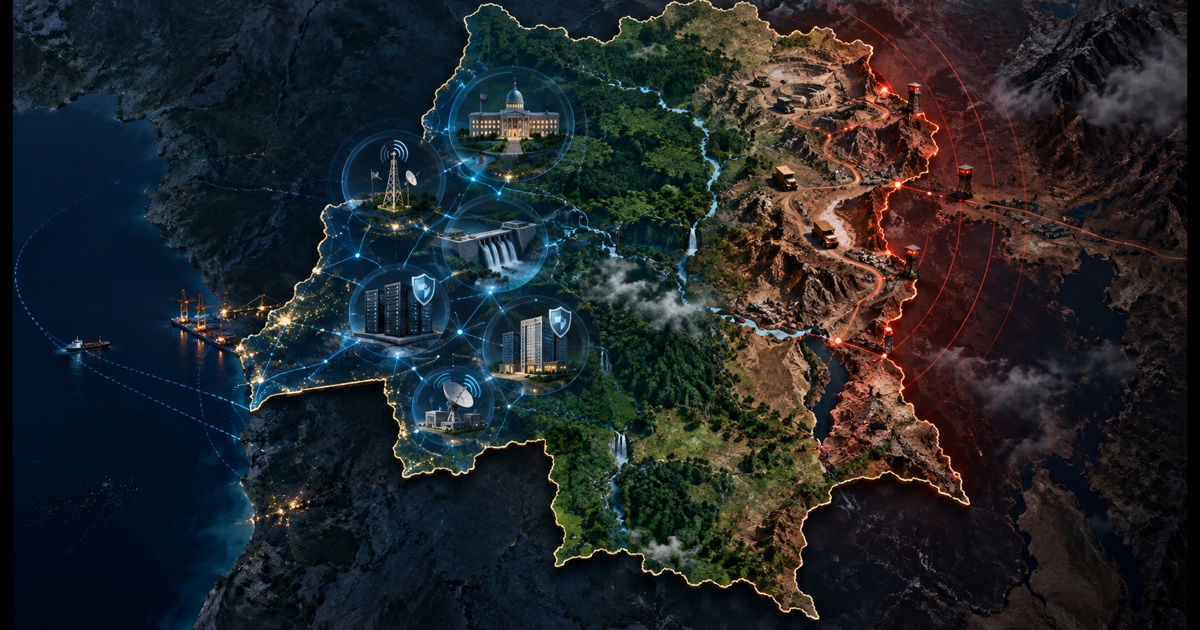
In the east, territorial pressure is documented. In the west, the concern lies in institutional, economic and information vulnerabilities. Confusing the two weakens the diagnosis; examining their links methodically can help build a state response.
An analysis by Fernandez MURHOLA
International human rights defender, public figure from the Greater Kivu region, Congolese civil-society leader and member of the World Alliance of Civil Society.
Kinshasa, 17 September 2026
Introduction: a war beyond the battlefield
The crisis in the Democratic Republic of the Congo can no longer be described simply as an internal rebellion. Since the M23's resurgence, the conflict has combined military operations, external support, territorial control, parallel administrations, resource extraction, population displacement and a contest over the narrative.
Strategic studies call this combination hybrid warfare. Its purpose is not always to defeat an army in a decisive battle. It may instead be to control land, roads, resources and administration while weakening the state's ability to understand the attack, prove what happened and respond.
The Congolese debate would benefit from separating three levels: facts established by independent sources; allegations that still require investigation; and political or geopolitical interpretation. A serious accusation does not become true because it sounds plausible. Equally, cautious language must not erase facts that have already been documented.
1. What the United Nations has established
The final report S/2025/446 of the UN Group of Experts describes substantial territorial gains made jointly by the Congo River Alliance/23 March Movement (AFC/M23) and the Rwanda Defence Force (RDF). It records the capture of strategic, mineral-rich areas of North and South Kivu, including Goma and Bukavu, and the establishment of parallel administrative structures in captured territories.
On 21 February 2025, the Security Council unanimously adopted resolution 2773 under Chapter VII of the UN Charter. It demanded that M23 end hostilities, withdraw from areas under its control and dismantle illegitimate parallel administrations. It also called on the RDF to stop supporting M23 and withdraw from Congolese territory without preconditions.
Those findings do not justify every extrapolation, but they rule out an overly narrow reading of the conflict. When foreign forces take part in operations, an armed movement controls cities and corridors, and a competing administration replaces state institutions, territorial sovereignty is directly at stake.
Article 2(4) of the UN Charter prohibits the threat or use of force against a state's territorial integrity or political independence. UN General Assembly resolution 3314 includes, among acts that may amount to aggression, a state's sending of armed groups or substantial involvement in their acts of force. A final legal determination belongs to the competent bodies, but the documented evidence calls for an assessment of international responsibility.
2. Control in the Kivu: describing the facts precisely
“Occupation” has a legal meaning. Under Article 42 of the 1907 Hague Regulations, territory is considered occupied when it is actually placed under the authority of a hostile army. The question is therefore one of effective control: military presence, the ability to exercise authority, the displacement of the national administration and the power to enforce decisions in the area.
The presence of an armed group alone does not necessarily establish that a foreign state legally occupies the territory. The relationship between that group and the foreign force must be examined, including command, joint operations, logistics, administrative structures and the extent of authority actually exercised. Report S/2025/446 provides substantial evidence on several of these points. Preserving and connecting that evidence will be essential in future proceedings.
Territorial control has practical consequences. It changes access to roads, border posts, airfields, towns and markets. It allows those in control to collect taxes, determine who can move, control information and select which businesses may operate. A military map shows only part of this picture: economic and administrative control can outlast a change on the front line.
3. Rubaya and the resource war
Rubaya shows how the economy becomes part of the conflict. The Group of Experts' report S/2024/969 examined AFC/M23's control of mining areas and the threat to mineral traceability. Report S/2025/446 says the movement retained its hold over several sites, trading centres and transport routes. It also describes increased risks of cross-border fraud, including the mixing of minerals from North Kivu with output declared as Rwandan.
It is not enough to say that Congo is being looted. The chain must be reconstructed: mine, tax collector, buyer, transporter, crossing point, certification mechanism, exporter and ultimate beneficiary. This turns a political denunciation into a dossier usable by investigators, courts, sanctions authorities or corporate due-diligence systems.
Pillage is prohibited under international humanitarian law and may constitute a war crime when the conditions of the Rome Statute are met. Criminal responsibility is individual. It cannot be assigned to a person or company solely because of nationality or participation in a supply chain. Accounting records, contracts, communications, financial flows and evidence that the person knew of the risk are needed.
4. Forced displacement and civilian protection
Civilians bear the heaviest cost of war. The 2025 report describes mass displacement, insecurity and grave violations of international humanitarian and human rights law. In occupied territory, the Fourth Geneva Convention prohibits the forcible transfer and deportation of protected persons, subject to narrow exceptions related to their safety or imperative military reasons.
The Bosco Ntaganda case shows that forced displacement may also engage individual criminal responsibility. The International Criminal Court convicted him, among other crimes, of forcible transfer and deportation for acts committed in Ituri in 2002 and 2003.
Claims of “demographic engineering” or population replacement require separate proof. Investigators must identify who was displaced, by whom and under what orders or pressure, where people were sent, and whether the settlement of another population was organized. Victims deserve more than a claim that cannot be substantiated.
5. The west: suspicion is not evidence
Official reports support the account of territorial control in the east. The idea of broad infiltration across the west does not have the same level of support in the sources examined. It should be treated as a security hypothesis and an institutional risk to audit, not as established collective guilt.
Infiltration cannot be inferred from a surname, origin, language or critical opinion. It must be demonstrated through covert financing, operational communications, orders, resource transfers, corruption, irregular access to sensitive systems or proven ties to a hostile organization.
This distinction protects both national security and the rule of law. Identity-based measures would produce arbitrary accusations, injustice and deeper social divisions. They would also distract security services from useful evidence. Counter-interference requires evidence, procedure and judicial oversight.
6. Five areas of vulnerability to examine
The lack of evidence for generalized infiltration does not mean the DRC can ignore its vulnerabilities. A national audit should examine five areas:
- Military: command chains, recruitment, access to operational plans, weapons stocks, communications and base security.
- Political and administrative: corruption, covert funding, sensitive appointments, document fraud and improper access to public information.
- Economic: shell companies, strategic contracts, mineral trade, banking, telecommunications, energy and critical infrastructure.
- Information: fake accounts, coordinated campaigns, manipulated content, purchased reach and forged documents.
- Data: hosting of public records, access to registries, network security and dependence on providers whose safeguards have not been verified.
The goal is not to police opinions. It is to protect the functions without which a state cannot make free decisions. Every control measure must have a basis in law, be proportionate to the risk, allow an effective remedy and be overseen independently.
7. The battle over the narrative
Hybrid warfare also seeks to impose a single explanation. Kigali invokes, among other things, the FDLR threat and the protection of Congolese Tutsi communities. These are real questions that must be addressed. The FDLR remains a dangerous armed group. Congolese Tutsi, like every community in the country, have a right to security and full citizenship.
Those imperatives do not, however, settle the central legal question: under what conditions may one state use force on another state's territory? Self-defence is neither an automatic formula nor an unlimited licence. It requires, in particular, an armed attack and remains subject to necessity and proportionality.
The psychological concept DARVO describes a sequence of denial, attack and reversal of victim and offender. It may help interpret some communication strategies, but it is not a category of international law. A legal case must rest on acts, perpetrators, evidence and applicable rules.
8. Negotiating without legitimizing gains made by force
Analogies with the Sudetenland, Munich or Donbas may illuminate a political mechanism, but they prove nothing on their own. The historical settings, actors and legal frameworks differ. Such comparisons are useful when they sharpen a precise question: can peace last if territory controlled through force becomes a permanent political advantage?
Resolution 2773 provides part of an answer. It calls for withdrawal from controlled areas and the dismantling of parallel administrations. Negotiations can establish a ceasefire, protect civilians, allow humanitarian aid, address the conflict's causes and prepare the return of lawful authority. They should not erase the rule against acquiring territory by force.
Minority protection must be part of any durable settlement. It does not, by itself, confer a general right of unilateral military intervention. Protecting a community and preserving territorial integrity are not opposing goals. A serious agreement must guarantee both.
9. From denunciation to a national doctrine of evidence
The DRC's first response should be documentary. It needs a secure system to preserve testimony, satellite images, medical records, troop movements, orders, communications, financial flows, mineral supply chains and information about command structures. Every item should be dated, authenticated and kept under a verifiable chain of custody.
This work can support several routes to accountability. Criminal responsibility concerns individuals. In October 2024, the International Criminal Court renewed its investigative efforts concerning crimes under the Rome Statute committed in North Kivu since January 2022. Congolese courts also have a central role, as do sanctions mechanisms and proceedings in countries that recognize certain forms of extraterritorial jurisdiction.
State responsibility follows different rules. In 2006, the International Court of Justice did not reach the merits in DRC v. Rwanda because it found that it lacked jurisdiction. Any new strategy must therefore begin by identifying a valid basis for jurisdiction, applicable obligations, and evidence capable of establishing the acts, their attribution and the harm caused.
10. A state counter-strategy that respects freedom
The DRC should adopt a resilience strategy covering defence, borders, resources, telecommunications, energy, banking, media and public data. It should assign responsibilities clearly, require regular audits and specify how to respond when several warning signs converge.
It must also reject shortcuts. A law targeting “foreign agents” must not criminalize criticism, journalism, research, political opposition or legitimate civil-society work. Restrictions on expression would weaken the country by limiting its ability to recognize and correct its own mistakes.
Five principles can guide the public response to information threats:
- cross-check strategic information before publishing it;
- archive coordinated campaigns and preserve their technical traces;
- make political and media funding transparent under the law;
- protect journalists, researchers and whistleblowers acting in good faith;
- help the public recognize fake accounts, deepfakes and manipulated documents.
Resilience is not the control of every voice. It is making the state harder to deceive, corrupt or paralyze.
Conclusion: defend the territory without abandoning the rule of law
Pressure on the Kivu and vulnerabilities in the west belong to different levels of evidence. In the east, the UN has documented RDF involvement alongside AFC/M23, territorial gains, parallel administrations and mineral supply chains. In the west, possible infiltration calls for targeted investigations and audits, not accusations against communities or the treatment of political disagreement as treason.
The country's future depends at once on its territory, civilian protection, resources, institutions, information and the memory of crimes. Peace will remain fragile if structures of predation survive. Justice will be powerless if evidence is lost. A security policy that abandons freedom will weaken the republic too.
The response must be precise: document what is established, investigate what is not, attribute responsibility and protect the functions of sovereignty. The DRC must turn resilience into policy, memory into evidence and law into an instrument of national protection.
Documentary references
- UN Security Council, S/2025/446, final report of the Group of Experts on the DRC.
- UN Security Council, S/2024/969, midterm report of the Group of Experts on the DRC.
- UN Security Council, resolution 2773 (2025).
- UN Charter, Article 2(4).
- UN General Assembly resolution 3314 (XXIX), Definition of Aggression.
- ICRC, 1907 Hague Regulations, Article 42.
- ICRC, Fourth Geneva Convention, Article 49.
- International Criminal Court, Prosecutor's statement on renewed investigations in the DRC, 14 October 2024.
- International Criminal Court, Bosco Ntaganda case.
- International Court of Justice, Armed Activities on the Territory of the Congo, DRC v. Rwanda.
This article presents the author's analysis. The references distinguish documented facts and legal questions from security hypotheses that still need investigation.